
If you’re considering Botox or other fillers, you may have done some research on what to expect by talking to friends, or reading articles or posts.
As such, you’ve likely stumbled upon the term “off-label use” and scrunched your face disapprovingly. Surely there must be a difference between FDA-approved and off-label use. And if you’re considering a cosmetic treatment, you don’t want some bargain basement procedure performed on your body, right? Because that’s what off-label use sounds like.
Off-label use is not that though.
Then What IS the Difference Between FDA-Approved and Off-Label Use?
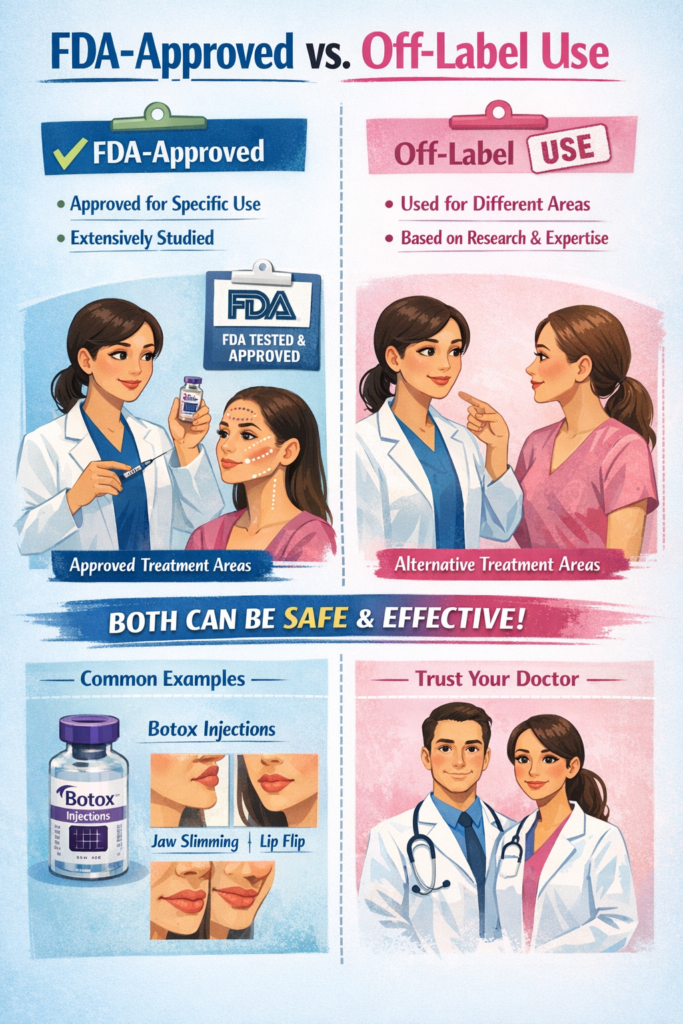
In a nutshell, a medication or medical device that is FDA-approved means that the U.S. Federal Food and Drug Administration (FDA) has determined that, based on testing and studies, it’s safe and effective for a specific use. Off-label use means the same medication or device is utilized for a different purpose, but is still based on research and your doctor’s expertise.
Off-label use is legal and legitimate, even though it does not have FDA approval.
Is Off-Label Very Common?
Yes! Anywhere from 20 to 60% of product or device use is off-label. Botox is one of the biggest examples of off-label use.
Known as botulinum toxin, Botox received its first FDA approval in 1989 for the treatment of eye conditions such as strabismus and blepharospasm. Since that time, it’s gone on to receive additional FDA approvals for several medical reasons, such as migraines and excessive sweating, as well as treating glabellar wrinkles (those angry 11s) and crow’s feet.
Given its wide range of effectiveness, Botox is used off-label for other medical and cosmetic purposes. It’s is one of the most effective ways to slim the lower face and help with jaw clenching in patients. Additionally, it can be used as a filler in the temples and tear troughs, and for lip flips and traptox, also known as Barbie Botox.
Beyond Botox, off-label soft tissue mesh is often used in plastic surgery as an internal bra, and for radio frequency devices used in areas other than the face. Whatever the case, all of these off-label applications are widely used and supported by extensive data and experience.
But How Safe Are Off-Label Treatments?
When used thoughtfully, intentionally, and by an ethical and highly skilled board-certified plastic surgeon, off-label use is completely appropriate. Surgeons often discover safe and well-studied applications for certain medications and devices that just haven’t gone through the long and arduous process of getting FDA approval.
So essentially, the safety and efficacy of off-label treatments are based on choosing clinics, spas, or plastic surgery centers run by only the most qualified and board-certified surgeons. This increases the likelihood that the patient will be treated in an evidence-based way with evidence-based protocols. It also assures that the patient will have adequate backup if needed.
Your doctor or specialist should be completely upfront with you about whether they’ll be administering off-label treatments or using off-label devices.
Are You Ready to Give Plastic Surgery a Try?
Now that you know the difference between FDA-approved and off-label use, it’s our hope that you feel more comfortable with whatever procedure you’re considering.
So if you’re ready to speak with a skilled and caring board-certified surgeon who will be completely transparent with you, contact us.
And remember, if your surgeon recommends an off-label treatment, that doesn’t mean it’s experimental or unsafe. It actually means your surgeon cares enough to tailor your treatment using tools they know are safe, effective, and that work.