
If you’re a woman, do you remember a time when you were unencumbered in some way by breasts and moved through life with ease?
For most women, this is a distant memory. By the time puberty hit, you were probably well aware that you would be developing breasts – if you weren’t already. These may have been difficult years. But by the time you arrived at young adulthood, the primary stages of breast development were complete. What a relief, right?
But that didn’t mean your breasts would maintain their 20-something appearance. While the physical size and shape of your breasts likely changed to some degree throughout life, if you went through any pregnancies, you may have experienced significant changes. And given how pregnancy changes breasts, it’s no surprise that some women seek breast augmentation or reduction surgeries once they’re done having children.
The Stages of Breast Development
Interestingly, breasts start to develop while in utero. An area in the chest thickens to become what’s known as the mammary ridge, and the milk line develops. By the time a baby girl is born, her nipples and the start of the milk-duct system have formed. But the chest is flat, and the breasts are largely ignorable. This is the first stage of breast development.
During the second stage, breast budding (medically known as thelarche) occurs. As they grow, the breast buds may feel sore or tender. Nipples and the skin around them (the areolas) may also get larger.
The breasts become rounder as fatty tissue and milk-producing glands grow in stage three. The areolas increase in size and may darken while the nipples become more erect.
Stage four brings changes to the areolas and nipples as they form small mounds on top of the breasts – giving them a fuller look. Yet, there is still swelling and tenderness until they are done growing. Once they reach that point, the breasts are fully mature and the areolas typically flatten back into the curve of the breasts with only the nipples raised. This is stage five.
What Can Affect Breast Development?
It’s difficult to say when a girl will start developing breasts. For some, it can begin as early as eight years of age. For others, it may be as late as 13 or 14. Whatever the case, breasts are usually fully developed by a woman’s late teens or early 20s.
Several factors determine the size and shape of a woman’s breasts. Genetics has a major role, though just because a young girl’s mother has large breasts doesn’t mean she will.
A change in body weight or fat percentage during the teen years can affect the structure of breasts, which are made up of glandular and fatty tissue. In addition, teenagers who are very active in sports may have increased muscle mass behind the breasts that will impact their size.
Of course, hormones are almost always culprits. The hormonal changes and shifts that occur during menstrual cycles can change the fullness and sensitivity of breasts. And then there’s pregnancy. The massive hormonal changes during this time drastically change the breast size, texture, and firmness.
How Pregnancy Changes Breasts
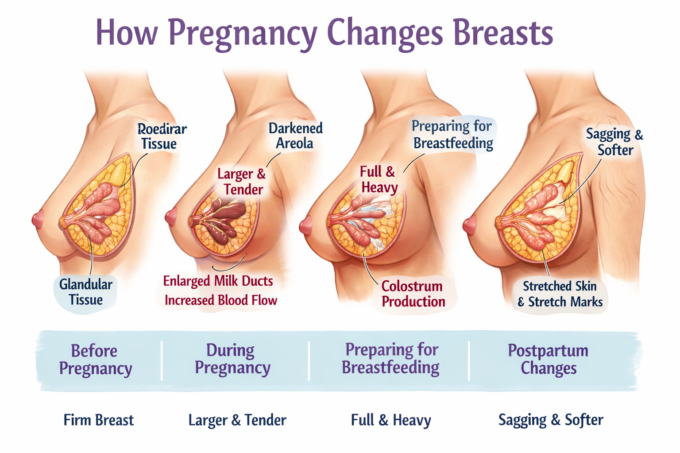
Once women hit the six-to-eight-week point of their pregnancy, they notice their breasts become bigger. The breasts are also more sensitive and tender as they continue to grow throughout the pregnancy. Most women, in fact, go up a cup size or two and their breasts may feel itchy as the skin stretches.
Additionally, the areolas and nipples darken because of hormones and increased blood supply can also darken the veins. By the end of the first trimester, the breasts may start leaking colostrum. The nipples and areolas also increase in size, with the areolas possibly developing bumps.
So yes. The breasts experience major changes during pregnancy. And with good reason! Their sole duty is to sustain life. But once nursing is complete, the pregnancies have left a lasting mark on a woman’s breasts.
Plastic Surgery to the Rescue
There’s no denying that pregnancy changes breasts in ways that aren’t always appealing. Fortunately, plastic surgery can be performed to restore the breasts to their original and more youthful pre-pregnancy position.
So if pregnancy has negatively impacted your breasts, contact us today to talk with one of our board-certified plastic surgeons. Depending on your situation, he or she might recommend a breast lift, breast augmentation, or breast lift with either silicone or saline implants.
And if your breasts have become too large after pregnancy and are no longer proportionate to your body, a breast reduction may be in order. Whatever the case, you’ll be in good hands.